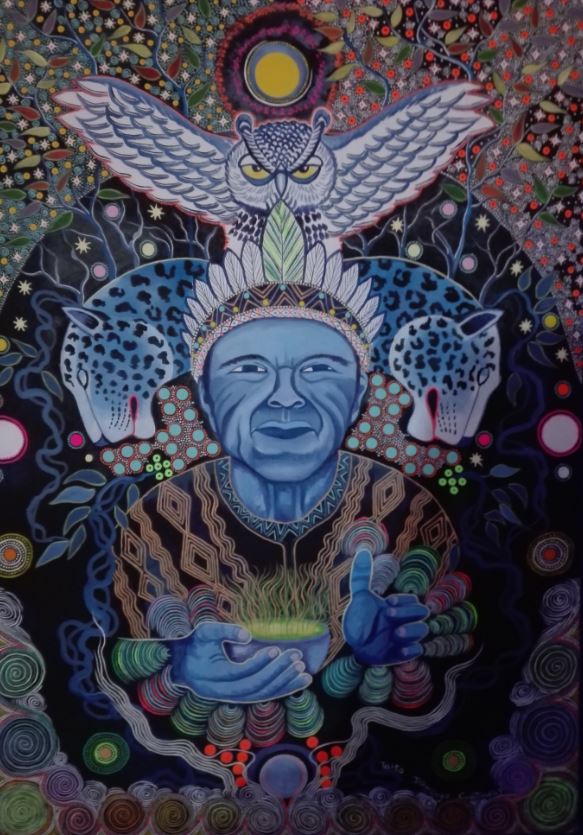
"Ayahuasca from insomnia", painted by Sofia Nalbadi, 2020
It all started in the
Sibundoy Valley, the indigenous people of the Camsá and Inga communities
celebrated the Festival of Forgiveness (Klestrinÿe), a tribute to the act of
forgiving, of reconciling and leaving behind differences and conflicts in the
midst of food, drink, partying and fun. This unique event would end with the
reception of the "Betsknate" (Big Day), a day that would start a new
cycle in the local calendar. It was February 20 and a series of events and celebrations
that would fill the atmosphere of the towns of the Valley - Sibundoy, San
Francisco, Santiago and Colón - with a feeling of brotherhood and intoxication began.
The smell of fresh typical food was in the streets, especially in the Central
Park, in front of the church, where several tents had installed improvised
kitchens to supply the diners. Craftsmen from various parts of southern
Colombia (Putumayo, Nariño, Cauca) and even from the Sierra Nevada de Santa
Marta exhibited the beauty of their weavings in backpacks, belts, bags,
ponchos, dresses; the skill of their hands was imprinted on pieces of jewelry,
handles, necklaces, earrings; the creativity of their minds in decorative
works, many worthy of a museum. The carved wood sculptures were a highlight, an
art that fused the indigenous cosmogony with shamanistic rituals and
self-recognition as an ancestral people. An art and craft show decorated the
public space.
Meanwhile, in the house
of the Cabildo, the slaughtered body of a pig, the largest ever seen by my
eyes, laid in front of skillful cooks, who once again demonstrated that there
is no event or crowd, large enough, that cannot be satisfied by the
organizational and logistical capacity of the indigenous peoples. The pork was
distributed in pots destined for sancochos
and tamales while enormous baskets of
chicha were emptied into the throats
of passers-by as they were produced. Thousands of people were expected that
weekend, including visitors of the region, tourists, rural dwellers, indigenous
people and settlers.
When we arrived at the
Maloca, it was eleven o'clock at night. Sofia and I were located in one of the
free spaces around the circumference: it was a warm space, completely built in
wood, about fifteen meters in diameter and a concentric corridor of one and a
half meters outside. The interior and the exterior corridor were separated by
wooden walls on whose walls were drawn handmade paintings: shamans transfigured
with animals, jaguars with penetrating glances, plants with striking flowers
entwined among bushes and vines, snakes that were being transformed into
rivers, macaws with imposing and colorful feathers, static hummingbirds in full
flight, waterfalls emerging from the base of a full moon, hallucinatory
paintings mimicked among multicolored fractals. In short, the biodiversity of
the tropical Andean ecosystems was embedded in landscapes painted in the style
of yagé visions. Violets, reds, yellows and greens predominated, but had no
physical limits, resembling the logic of Milky Way images, like a transition
between colors that you never know where they start or end. The marked geometry
that permeates each scene of the works indicated that they had been faithfully
captured from the artist's vision in one of his mystical journeys.
In fact, my ritual had
begun months before in Germany, when I had decided that I wanted to explore the
depths of my subconscious and unconscious, something I had read about the
medicinal and sensory properties of ayahuasca. Also, the stories of a few
friends who had experimented with the plant had ignited my curiosity. Their
stories would be far from what the journey would show me that night. For months
I fantasized about the hundreds of possible scenarios in which I could take the
medicine, the different sensations I could have and the visions I could create,
all the images were extracted from words and texts, from the abstraction of
what my mind imagined the cosmic journey would produce.
If you want to have an
experience with yagé, there is no better place than Putumayo, that region of
southwestern Colombia where the knowledge of the Amazon region and the Andes
mountains converge. For that reason, when in September 2019, Sofia and I began
planning our trip of environmental and cultural exploration through the north
of South America, the town of Sibundoy began to take shape on the route that
would take us from Bogotá to southern Bolivia.
At the beginning of
February, I had established virtual contact with Ciro, he would be the one who
would lead the ceremony. Through the w app chat he seemed a severe character of
few words. When we met personally in Sibundoy he made me feel a trust between
us. Ciro is dark-skin (not afrocolombian), with undeniable Camsá features,
fresh and parsimonious appearance, calm when talking and moving, lover of
laughter and joy. I would never have thought at that moment about the
mystical-spiritual power that this man's words, intonations and songs would
exert on my hallucinations. Two weeks before I arrived in Sibundoy I started a
diet that tended to be vegetarian. I wasn't as strict as I could have been,
although it was quite a sacrifice. Milk and meat stopped being part of my diet
as I traveled through Risaralda and the Valle del Cauca on my way to Putumayo.
I considered it a pity to stop eating the animal delicacies that Paisa and Valluna gastronomy offered on their way.
On the night of the
ceremony, I was the only assistant who would take the ayahuasca for the first
time, I found myself expectant: without fear, though with anxiety. With me in
the maloca, there were about ten more people, Sofia would be at the ritual,
even though she had decided beforehand that she would not take the medicine,
but would of course accompany me, as we had promised each other before we left
Germany. Around eleven forty the other attendees and I sat around the fire that
burned in the middle of the Maloca. Sofia lied on her mattress, in a sleeping
position, ready to abstract herself from the surroundings. Ciro's brother, was
quietly stoking the fire. His role would be essential in the hours to come, he
was a guardian of the visions, a watcher over the evil spirits. With one hand
he would hold a pot containing palo santo
extract and with the other a few dry branches with which the wind would blow to
incinerate the dry sap of the ancestral tree. Intense amounts of smoke came out
of this pot and built up a gloomy atmosphere for the spirits of other times and
other spaces to visit, talk, and stay with us.
The shaman (taita),
standing at one end of the maloca, played his harmonica and shook some dry
leaves as a percussion. With a delirious beat, I conceived a surreal atmosphere
that invited trance and at the same time led me to other dimensions of the
mind. The taita was placed in front of a table of about two meters long where
there were jars, plants, scapulars, pots, mugs, and, in a plastic bottle, the
yagé.
While music filled the
gloomy ether, there was no spatial dimension, there was only the
maloca-somewhere in what we call the universe. Even the word space itself, was meaningless at the
time, the situation only seemed to be real because was seen to be happening and
therefore it must have had a place. Time had stopped. I was calm, but I felt
alert, expectant, perhaps a little afraid, of encountering unknown beings who
were hiding among the sounds, or among the smoke, or who were coming from the
dark countryside surrounding the maloca. Some sinister being that I did not know
of from the dark side. Uncertainty with anguish.
After half an hour of
chants, mantras and prayers: "Sana sana yagesito, yagesito, yagesito...
cura, limpia, limpia", the shaman began to call us one by one, there were
five or six of us to take. When he mentioned my name, I approached his table
and received from him a glass almost full of a thick substance, brown almost
black. I sipped it and felt that I was facing something that was overflowing me.
“Buen provecho" said the taita. I returned to my stool around the fire.
With difficulty to
concentrate, I managed to dialogue with myself for about twenty minutes, trying
to trace a purpose for my journey with the yagé. Focusing on being still, calm,
and reflective made that time a relentless wait.Suddenly I felt like throwing up, I knew that
it would be one of the effects of the plant, so I let myself go. I went out
into the hallway and threw up once, twice, three times, ten times... I didn't
stop for several minutes, first the aguapanela
with cookies that I had drunk hours before, then water, then air, then nothing,
then thoughts, regrets, guilt, remorse, debts, demons, spirits. They were
attacks of vomiting, the most intense I had ever had in my life. It was
physical vomiting, a body detox, a struggle between the body and the plant to
take control of the stomach and liver. But it was late, the powers of the
spirits had begun to dominate not only those organs but also my mind, my
reality, and my subconscious.
The portal to other
worlds would be opened to all, the fire´s master (Ciro´s brother), with his
scarce tools, would fabricate smoke of palo santo from his pot for those who
between attacks of vomit would painfully expel the weights of the body and the
soul; also for those who, falling in a dreamlike precipice, would go infinitely
towards the bottom of the desolation. The cloud of smoke offered a link so
that, from the depths, the souls returned to this dimension.
The moment I began to
vomit, the palo santo smoke wrapped me in its mantle and abstracted me from the
first impulse of the plant to drag me into the unknown. When I finished
vomiting, I returned to the fire, but I was no longer the same, I saw the world
with different eyes, the eyes of the ayahuasca. I sat around the fire and felt
suddenly drunk, lost, out of control, like a first-person viewer of a scene of
psychedelic terror. The floor became slightly deformed, acquiring a character
of fluidity. The colors were not the same, they were more alive and more
mobile, changing, liquid and ephemeral like the edges of a pond hit by soft and
slow waves that come and go incessantly. I never believed that reality could
escape from me so easily, that suddenly, in a matter of minutes, the existence
was reduced to an exact moment that I could not even be the protagonist of.
That the ideas clinging to the objectivity of science and the precepts that the
only valid and existing thing is what can be seen, touched, smelled and
perceived with the senses, and furthermore, be physical, tangible and
verifiable, were reduced to a pure discourse, of course useless and fallacious
at that moment. I felt incapable of understanding and reasoning the world in
which I found myself. Thus, I felt that life had deceived me, that it had
always biased me by disbelieving in the magical, that it had sold me a wrong
idea of the real, but now in this
other dimension, in itself also real (because if you live, of course it exists
in some dimension), I was blind and adrift.
From that moment the
plant took control of my senses, my fears, my secrets, my understanding of
time, space and corporeality. The being
that lived in me looked around, his
eyes found a painting where a jaguar was surrounded by an aura painted with all
the colors of the universe, walking in a firmament of eternity, a God that
examined the ritual from the cosmos. The jaguar not only looked straight into his eyes, but entered his mind. I felt weak.
"My ancestors tell stories about the tiger, that when you walk the
territory you must give a safe and firm step, because when the tiger smells
your footprint he knows if there is fear in it"
Eliana Maria Muchachasoy Chindoy
Frightened by the
jaguar's insufferable and penetrating gaze, I felt deeply watched. I considered
myself tiny, with a dissolved ego. Thus, vulnerable, so overwhelmed that I
could not hold my gaze on the painting, I had to flee, my spirit felt prey of
that powerful predator. In the cosmogony of the Amazonian peoples, the shaman
merges with the jaguar when he enters the cosmic world of ayahuasca. In the
words of (ACEG 2010) "The jaguar is the allegory of the figure of the
shaman in his thinking, that guardian, healer, medician, guide, who travels
between worlds, and, both in the story and in reality, merges into the
boundaries between human and animal”.I
was in the territory of the jaguar, and it is during the ritual, at night, that
he is most alert. For the Desana, indigenous people of the upper Vaupés basin,
"the jaguar is the representative of the Sun; it symbolizes the
fertilizing energy of nature; it is the protector of the maloca and the forest;
because of its color, it is associated with fire, and because of its roar, with
lightning" (Brezzi 2003). The whole environment around me was the ideal
habitat for the jaguar.
I walked to the
mattress I had on the ground, Sofia was lying on a couple of blankets, covered
with a blanket up to her head, in a great effort to ignore what was happening
around her, that magical and at the same time terrifying atmosphere of
delirious music, people vomiting and struggling to survive hallucinations of
all kinds. She didn't know what was coming. I approached my place and looked at
my blankets, with each step I took, the yagé took more control. I thought that
being at rest and lying down I could get around this ghostly state. As I layed
down on the mattress I felt my body flowing like a waterfall of water falling
uncontrollably to the floor. The objects came to life, they seemed to have an existence
of their own, the alterations in perception were not only visual, but tactile
and auditory. The texture of the blankets resembled that of a pond, elusive. I
was trying to cover myself with a slippery stream of cloth. I sank in the
ground, almost flowing through the cracks of the wood, of the folds of the
blankets. The sense of touch was completely removed from reality, the vision
combined with my palpation to give me the impression that the physical limits
of my body were displaced a few millimeters outside of me.
Within this watery
world I felt as if I were drowning, it had only been a few minutes after I had
gone to bed and I already felt that I had no air to continue breathing, that I
had lost the battle for survival. My lungs expressed their helplessness to take
in oxygen through screams, since the air became water and that was what I was
breathing. -Ahhhh... Aaaahhhh, ujj, ujj, hmmmm hhhmmmmmmm... -the water was
beginning to invade my air and my head and my moans were expressing the denial
of entering the world of visions. My body was writhing back and forth in
agitation from the complicated breathing.
I was watching a double
distorted image of my body as if it were a screen out of focus, seeing and
being at the same time. The materiality of the body didn't exist, there was an
additional dimension in space. My existence ceased to be what it had been for
29 years, to be and to be in other worlds and my subconscious was the main
accomplice. But how could I know that this was the subconscious and not the
conscious if the subconscious never emerges consciously? And I felt totally
conscious. It was right between this syllogism where the real and the fantastic dissolved, where the plant showed me that it
was fluid, abstract, ephemeral, relative, fleeting, like smoke. I don't know
how long I laid there, feeling like water, in the midst of pintas (visions) that were consolidated as the most irrefutable
objectivity. Struggling not to fall into despair, I refused to see what I
actually saw and to experience what I undoubtedly felt. I felt that everything
was insignificant and trivial, that I was caught in the middle of a nightmare
of colors, strange beings, vomiting, terror and loss of control over myself and
my situation.
Yagé's Dream
"Taita yagecito cleanses body, spirit and heart,
Grandpa sings, sings your prayer,
Granddaddy paints, paints healing.
Eliana Maria Muchachasoy Chindoy
The desire to escape
led me outside, into the corridor, the vomit reappeared again, more severe than
before, there was nothing to expel, perhaps only my last defences against the
plant. Perhaps sin and demons. As I threw up noise from my mouth I felt a presence
behind me, in those short seconds of rest between gagging and gagging I looked
back and amid colorful visions and blurred shadows I saw someone… Was there
really? On the grass where I released my bitter fluids, I saw lizards moving in
the middle of a pond of varicolored hexagons. The fear of darkness and the
imperceptible presence brought me back to my mattress, what was to come would
be an episode I describe as: the bottom of hell, between abandonment and
desolation.
The repetitive notes of
the harmonica and the ancestral songs performed by the shaman moved through the
ether of palo santo smoke.
Abandonment and death
In my bed again, among
the blankets, lost in the folds of a shawl, drowned in my water world I managed
to see in a fleeting appearance, the jaguar that was chasing me. He was
criticizing my weakness, I was not stepping firmly and he knew it, I was
showing it too, I buried myself in the despair of my sheets with the aim of
escaping his glance. I felt abandoned and terrified, forgotten by everyone in
the depths of my despair, drowned by my own fears. I tore my throat screaming
for help - Ahhhh... Ahhhh... Help! - For several minutes, incessantly my voice
grew louder and louder. As I squirmed in my place, multitude of visions one
after another appeared as real as vivid dreams in front of me. Dreams that only
let me rest when the bursts of palo santo drowned me for seconds. When I opened
my eyes and saw the maloca in a state of unwavering passivity, that was no consolation
at all. The screams came back - Aaahhh... Ahhhhhhhhh, God, God, God! -God?
-Where did this call come from? If many years ago I had decided to dismiss it
from my rationality. It was not in vain that Hofmann and Schultes wrote that it
seemed that the idea of divinity could have appeared in humanity thanks to the
use of hallucinogenic plants in the most primitive stages of the evolution of
the species, since these plants allowed humans to communicate with spirits or
deities. This communication through intense depersonalization brought healing
or at least answers to the most convoluted concerns, as granted by a wiser and
unreachable being.
But even the power of
the deities could not redeem this human remains, since they were who spoke through
delusions on the other side of existence. - It helps... Taita, taita, ahhh,
ahhhhh. Ciro! Ciro!... Help me please - I exclaimed with different intensity,
sometimes begging, sometimes demanding. The ego was dissolved, any sign of
arrogance had been undone. - Help me... Please... ahhh ahhh. Mom, mom, mom-.
They were cries that I
had never expressed because my spirit had never (or consciousness) been at such
a level of desolation and despair. My mind was in agony from the depths of the
abyss. - Dad! dad... Sofia, baby... love! love! love - I heard myself saying
between vibrant words while with my eyes wide open I watched the roof of the
maloca and the shaman playing his harmonica while my body distorted forward
trying to find a comfortable position, as if that would end the delirium.
-Sofia... Love... Help me!... - I repeated in the hope that my most faithful
companion and confidant would rescue me -Sofia, I love you... love, love, love,
aaaahh - I begged her even though I knew I was asking her to get involved in
something I had asked her to keep out. But there was nothing she or anyone else
could do. -Taita, taita, help, help," I cried as my body melted like
butter in the fire of that mysterious passage from living being to object.
There I understood what Jesus might have felt when he asked his father
"why did he leave him? Hours later, when I reflected and remembered with
Sofia what had happened that night, She would confess that she was facing one
of the most distressing anxieties. That while she listened to me in the midst
of the terror asking for help, she went out into the corridor of the maloca to
avoid seeing and hearing my "suffering", that she had smoked all the
cigarettes she had left and that she had asked the taita to help me out of the
world of dreams. He replied that neither he nor she, nor anyone else could do
anything, that it was a fight I had to give and from which I had to get out on
my own.
The screams ripped
through the dense air of the ritual, flooded with palo santo smoke and the dim
light of the candles afire throughout the maloca. - Mama... ma... dad...
Ivan... Help, I have a lot, I have a lot... I have a lot... -. Sofia would tell
me hours later that I never finished the sentence... In my visions I knew what
I had: a mixture of cold and fear. I thought about it, but I couldn't say it,
every time I understood what I had and what I wanted to say, the words vanished
after a few seconds (or minutes) of hallucinating around that lack... Everyone
in the maloca heard it and I remember thinking at that moment, "I am very,
very afraid”. I was afraid of getting stuck in that world with myself. I also
felt very cold.
My visions were
appearing and disappearing at a speed that did not allow me to understand or
analyze them. I invoked the Taita Marcelino, the highest authority in the
family's lineage of shamans, who had initiated the tradition of yagé in the
house, the most powerful of the Taitas. But no one came to my aid. The battle
had to be fought alone. It seemed infinite.
A jungle world fell on my pintas
for eons... -ggggguuuuhhhhggg uhhhhggg...- the howler monkey that I had seen in
the Tayrona National Park and in the forests of the Andean mountains in
Risaralda, entered my mind and my throat, he expressed himself through my
guttural sounds. I still remember them. Then the spectacled bear walked for a
few moments in front of me. He seemed to be calm and peaceful, as if he had no
desire or destiny. The jaguar once more -gggrrrrrrr grrrrr, Ahhh... ahhh - the
cries of despair did not stop either. The horse - bbrrrrr bbrrrr -.The animals were blended with the suffering
of having lost their identity forever, of having been possessed by different
animals for the rest of the history of the natural world. "Plants, animals, and humans merge and exchange identities with the
being in rapid flashes of transformation, and the shock of that encounter permeates
all things [...] It is in this realm of visions that the enormous human ego
dissolves in the face of essential truths and interconnections."
(Stone 2012, 1). The dog – barf, barf, barf-.
The Camsá Indians call it pintas,
because it comes in colors, as in paintings. The pintas showed me a group of indigenous,
a woman and several men. They were on a mountain and were gathered around a
large pot where they cooked medicinal plants. That was several decades ago,
when they began to populate this high part of the Putumayo River Basin. They
were learning how to prepare yagé, how to cook it, they were making mistakes,
but they were learning.
The hallucinations jumped from one situation to another, stubbornly
showing me something mysterious. I begged for the help of my other friend, with
the desire to exhaust every last resource, - Jessica, help, help… -. At some
point, Jessica came, I remember her well, she told me "relax, everything
will be fine, remember that it is temporary", and she left. Her image
appeared as a salvation, a bond that returned me to the world of the living,
ephemeral. Her words encouraged me a lot, but my world of visions showed
another reality. Seconds later, I would feel myself falling again. The tanatos' impulses returned in the form
of vomit, heavy and continuous, another battle against death, the guardian with
his pot of smoke tried to relieve me several times. I managed to sit down and
look around, I suppose it was about three o'clock in the morning. Between words
that cost me to articulate I asked for a bucket to be able to vomit from my
mattress, I did not want to go out again to face the darkness. The music of the
taita did not stop, the harmonica repeated its same hypnotic and pleasant,
although hallucinating three chords. I looked at Sofia, she was lying on her
half-side with her back to me. I worried about her, I felt compassion and
affliction for her. Are you okay, baby? She didn't answer. Maybe I just thought
about it, and didn't say it.
The vomit was coming back. - Uhhhhaaarrr, Uhhhhaaaagggggrrrr, Ahhhh!
Ahhh, Ttpppp - I was expelling bitter saliva, the bile. After about twenty more
minutes, the intensity diminished between every time softer and blurred
visions. I made a few jokes in my head, I don't know which ones, but I smiled.
I yawned for a long time and felt very comfortable, warm, in a quiet
atmosphere, I looked around and everything was silent, the light was dim, many
candles had been extinguished. The last firewoods of the fire were still
burning. Next to the fire were Ciro and Jessica, they were talking quietly, an
atmosphere of friendship was perceived. The instrumental music of Andean
ceremonies was playing on a cell phone, it had only stopped while the shaman
played his harmonica. Until that moment, I could feel it. I returned to myself...
suddenly the visions ended and a feeling of lightness and fullness invaded me.
An illumination, the nirvana. Clear ideas, lucubrations, understanding of what
had happened. Tranquility and peace, as if I had understood the purpose of that
whole journey. Tired, yes, but satisfied. For about fifteen minutes I remained
as an observer of the visions or dreams of that distant past. Here again, in the
calm, like someone who looks back and sees the destruction of the hurricane
that passed, but appreciates having lived in spite of the devastation.
A journey to hell and to the gates of death. But a triumphant return,
with more wisdom. The yagé is the plant that opens the door to the secrets of
the spiritual world, to the subconscious, the entrance to nature and to
ourselves, which in the end is the same thing.
I got up... I went to the fire, it was maybe 3:50 in the morning. I sat
down on a stool to warm up. The taita came and sat near me, he looked
immaterial and sublime, illuminated by the shadows of the subtle flames. - How
was it? You passed the test - he said and continued - ...all people see
different revelations, it depends on many things -. He told me the method to prepare
the ayahuasca and how it had guided them (him and his family) through the
decisions of the family. - Yagé is the plant of understanding and wisdom, it
speaks, but first it cleans. Next time you will see other things, do you want
to drink again? -.
Six hours later, the taita was performing a purging and healing ceremony
where he impregnated me with oils and plant essences while with a syncretic
tongue between Spanish and Camsá asked the spirits for my physical and
spiritual healing. The healing and cleansing process was just beginning.
Six months later ... looking back
Thoughts collected and narrated from
a “I” and a “we”, after dialogue with other people who also took ayahuasca
We understand the beauty of being alive when we face the death.
The yagé ceremony is an one-off event and can last a few hours. However,
it is the starting point of a more extensive process, where the understanding
of what we are capable of doing and the reflection on our limitless mental and
spiritual capacities make their way through the days. From the very moment of
the experience of dialogue with ayahuasca and through the days, weeks and
months after that memorable journey to the roots of Mother Earth, a new way of
discerning the depths of our being-thinking-feeling of the one we weren't aware
of before appears.
Only now, six months after that unforgettable February 20, the lessons
that ayahuasca has left me begin to take shape. Only in hindsight does my story
make sense. Although during the visions of the yagé, there could be episodes of
terror, anguish and desolation, even of regret for having undertaken that
spiritual search, I must emphasize the strength and determination that the
plant has given to my character and my personality, which seen from the
present, they make the healing and curing process that I had to go through
valuable. Altogether, the problems or challenges of daily life are no longer as
heavy as they used to be, instead, now I can cope with them more easily. I have
also learned to be less critical of myself when it comes to triviality, since finally,
¿what is ultimately so important in the end in a time-limited existence? In
short, I feel that I have an extra knowledge and an ability to connect the
objective with the imaginative, which I would not have been able to acquire
otherwise, a quality that allows me to advance in the search for a fuller and
happier life. And in this sense, recent scientific studies on the effects of
psychedelic substances on the structure of the brain and our thoughts have
indicated that after their use, "brain activity becomes more complex, rich
and diverse, which in short it can be understood as an increase in the dynamics
and richness of ideas and imagination” (see chapter at the end of this entry “The
Psychedelic Experience”).
It is fair to note that my experience is only mine, and that there are
people who react completely differently to the plant, with visions and trips in
space-time of clear lucidity, or dialogues with known or unknown beings, but
with a high charge. of wisdom, or, on the other hand, revelations and
illuminating truths. Also, there are those who return to their daily routine
and continue to be the same as before.
The meaning of the yagé ceremony and its subsequent effects on the
personality can be analyzed from two perspectives: its social significance and
its personal significance.
There are traditional and ancestral practices that mark the passage from
adolescence to adulthood in different cultures. The Bukusu in Kenya undergo a public
circumcision where friends and family are invited to watch the parade of the
naked teenager while the ceremony takes place. The Sateré-Mawé people of
northwestern Brazil enter maturity after a long ritual where they endure bullet
ants stings for several sessions over a period of months. On the other hand,
Inuit or Eskimo children of northern Canada go out at the age of 11 or 12 to
hunt with their parents to begin to get used to the harshness of the Arctic
climate and to acquire the dexterity that the role of man assigns them in their
community, this practice requires at the same time that the shaman of the tribe
prays in order to open communication between men and animals to connect nature
with hunters. Meanwhile, the Maasai of Kenya and Tanzania sleep one night in
the open forest before a feast of songs, dances and food that includes the
consumption of cow blood. On the other hand, the people that inhabit the islandof Pentecost in Vanuatu, Oceania, celebrate the passage to adulthood and
reaffirm masculinity through a ceremony where men have to build a wooden tower
between 20 and 30 meters from which they jump with lianas tied to their feet
(similar to Bunge jumping, but without elastic ropes). Finally, the Algonquins,
North American natives that extend from northern Mexico to Canada, go alone for
several days to hunt a deer in the forest as a way to prove that they will be
able to provide food for their community. Another ritual of early adulthood
practiced by this town is the consumption of a hallucinogenic drink called wysoccan, which causes amnesia that can
make them forget their family and friends, their entire childhood stage, and
even how to speak.
What is common between these rituals of stage change or advancement to
adulthood is the fact of having to go through harsh physical and mental tests,
sometimes an approximation to death, other times a stage of physical suffering
or emotional stress never experienced before. The victorious return after these
tests implies a rebirth, a stage closure and a beginning of another that
requires greater knowledge and skills. According to professor César Iván Bondar
(Doctor in Social and Cultural Anthropology from CONICET in Argentina), the
experiences during the “passing rituals” should be analyzed from the perspective
of the context and not of the observer's culture, since the significance of
pain or suffering for some, it can represent pleasure or enjoyment for others.
This raises the reflection of the mystique of yagé and its significance in
front of our eyes. Are vomiting and screaming suffering? Or can we rather
understand them as a period of healing and exorcism? The last interpretation
takes on relevant validity if we consider that this is precisely the role of
plants and the role of the shaman in Amazonian indigenous medicine.
The passage to adulthood is a common practice that has faded between the
evolution of the current easy and trivial world and that is now expressed in
ceremonies as simple as the "quince años" for teenage girls in Latin
America, equivalent to the "sweet 16th" in North America or even to a
simple drinking party for adolescents when they turn 18. Given this fact,
several questions arise: Are people today
prepared to be adults? How are they different from a child? age, appearance and
a document? And where does the mental and spiritual maturity lie?
In my particular case, the mystical journey of ayahuasca has been
filling me with vitality from then until today. The memories of that night come
back to me frequently, no longer fearless, no longer the weight of anguish, but
rather with the consistency of a lifelong learning experience. Ayahuasca has
opened to me the channels of understanding for many dimensions in the
intellectual, the personal, the emotional and the spiritual aspects, of course,
it is a process of permanent assimilation, but every time I have to analyze
complex situations in my daily life, or take decisions about what to do and
what not to do, I feel that, deep down, the plant guides me, showing me a light
to differentiate the trivial from the important.
Sometimes when I have to face daunting challenges, I think back to that
moment where I felt lost in the midst of ghostly visions that seemed eternal.
Then, these challenges (on the material and mental plane) become so
insignificant that they are faced with the calm, fluency and patience that
allow me to advance until I overcome them. To the question of whether, could I hold on to another moment in my life
in which I have overcome an overwhelming situation to gain strength in the
current difficult moments? Perhaps I would answer categorically that one
always tends to take the hardest moment of all as a reference. For this reason,
I feel that the visions of yagé and its journey have given me strength in
moments of anxiety.
Rites of passage or the change of stages in life have historically been
linked to an event that transforms the mind or body, to a test of endurance and
perseverance. Certainly, in our current society it is impossible for us to go
hunting in order to test our suitability for the passage to a new stage.
However, what is relevant is the importance of carrying out a ritual or
practice that prepares us to take on a new phase of our lives. That closing and
beginning ritual was for me ayahuasca.
-Asociación
de Centros de Estudios Gnósticos, Antropológicos, Psicológicos y Culturales
(ACEG). 2010. El mito del tigre en las culturas indoamericanas. Bogotá:
ACEG.
-Brezzi,
Andrea. 2003. Tulato: ventana a la prehistoria de América. Bogotá:
Villegas Editores.
-Schultes,
R. E. & Hofmann, A., (1982) Plats of the Gods, Origins of hallucinogenic
use.
-Stone, Rebecca. 2012. The Jaguar Within: Shamanic
Trance in Ancient Central and South American Art. Houston: University of Texas Press.
Ayahuasca desde la vigilia. Pintura original por Sofia Nalbadi (2020)
Todo comenzó en el Valle de Sibundoy, los indígenas
de las comunidades Camsá e Inga celebraban el Festival del Perdón (Klestrinÿe),
un homenaje al acto de perdonar, de reconciliarse y dejar atrás las diferencias
y los conflictos en medio de comida, bebida, fiesta y diversión. Este
inigualable acontecimiento finalizaría con el recibimiento del “Betsknate” (Día
grande), un día que daría inicio a un nuevo ciclo del calendario local. Era el
20 de febrero y se iniciaban una serie de eventos y celebraciones que llenarían
la atmósfera de los pueblos del Valle -Sibundoy, San Francisco, Santiago y
Colón- de un sentimiento de fraternidad y embriaguez.
Se respiraba en las calles el olor de la comida típica fresca, especialmente en
el Parque Central, al frente de la iglesia, donde varias carpas habían
instalado cocinas improvisadas para suplir a los comensales. Artesanos de
varias partes del sur de Colombia (Putumayo, Nariño, Cauca) e incluso de la
Sierra Nevada de Santa Marta exhibían la belleza de sus tejidos en mochilas,
chumbes, bolsos, ponchos, vestidos; la habilidad de sus manos se imprimía en
piezas de joyería, manillas, collares, pendientes; la creatividad de sus mentes
en obras de decoración, muchas dignas de museo. Llamaban la atención las
esculturas talladas en madera, un arte que fusionaba la cosmogonía indígena con
los rituales chamanísticos y el auto-reconocimiento como pueblo ancestral. Un
espectáculo de arte y artesanía decoraba el espacio público.
Mientras tanto en la casa del Cabildo, el cuerpo
sacrificado de un cerdo, el más grande alguna vez visto por mis ojos, yacía
frente a habilidosas cocineras, que una vez más demostrarían que no hay evento
ni multitud, por más grande que sea, que no pueda ser satisfecha por la capacidad
organizativa y logística de los pueblos indígenas. La carne del porcino se
repartía en ollas con destino a sancochos ytamales mientras enormes canecas de chicha se vaciaban en las gargantas
de los transeúntes al paso que se producían. Ese fin de semana se esperaban
miles de personas entre visitantes de la región, turistas, habitantes de la
zona rural, indígenas y colonos.
Cuando llegamos a la maloca eran las once de la
noche. Sofía y yo nos ubicamos en uno de los espacios libres de la
circunferencia: era un espacio cálido, completamente construido en madera, de
unos quince metros de diámetro y un pasillo concéntrico de un metro y medio en
el exterior. La parte interna y el pasillo exterior estaban separados por muros
de madera en cuyas paredes se dibujaban pinturas hechas a mano: chamanes
transfigurados con animales, jaguares de miradas penetrantes, plantas con
flores llamativas enredadas entre arbustos y lianas, serpientes que se transformaban
en ríos, guacamayas de imponentes y coloridas plumas, colibrís estáticos en
pleno vuelo, cascadas aflorando de la base de una luna llena, pinturas
alucinantes mimetizadas entre fractales multicolores. En pocas palabras, la
biodiversidad de los ecosistemas andinos tropicales se encontraba embebida en paisajes
pintados al estilo de las visiones del yagé. Los tonos violetas, rojos, amarillos
y verdes predominaban, pero no poseían límites físicos, se asemejaban a la
lógica de las imágenes de la Vía Láctea, como una transición entre colores que
nunca se sabe dónde empiezan o terminan. La marcada geometría impregnada en
cada escena de las obras, indicaba, que éstas habían sido fielmente plasmadas desde
la visión del artista en uno de sus viajes místicos.
En realidad, mi ritual había comenzado meses antes
en Alemania, cuando había decidido que quería explorar las profundidades de mi
subconsciente y mi inconsciente, algo había leído acerca de las propiedades
medicinales y sensoriales de la ayahuasca. Asimismo, los relatos de algunos
pocos amigos que habían experimentado con la planta me habían encendido la
curiosidad. Sus historias estarían muy lejos de lo que el viaje me mostraría
esa noche. Durante meses fantaseé acerca de los cientos de escenarios posibles
en los que podría tomar la medicina, en las diferentes sensaciones que podría tener
y las visiones que pudiera crear, todas las imágenes eran extraídas de palabras
y textos, de la abstracción de lo que mi mente se imaginaba que pudiera
producir el viaje cósmico.
Si se quiere tener una experiencia con el yagé, no
hay mejor lugar que el Putumayo, esa región del suroccidente colombiano donde
convergen los saberes de la región del Amazonas y las montañas de los Andes.
Por esa razón, cuando en septiembre de 2019, Sofía y yo empezamos a planear nuestro
viaje de exploración ambiental y cultural por el norte de América del Sur, el
pueblo de Sibundoy se empezó a perfilar en la ruta que nos llevaría desde
Bogotá hasta el sur de Bolivia.
A principios de febrero, había establecido contacto
virtual con Ciro, él sería quien
dirigiría la ceremonia. A través del chat parecía un personaje severo y de
pocas palabras. Cuando nos encontramos personalmente en Sibundoy me hizo sentir
confianza. Ciro es moreno, de rasgos Camsá
innegables, aspecto fresco y parsimonioso, de tranquilidad al hablar y al
moverse, amante de la risa y la alegría. Nunca hubiera pensado en ese momento acerca
del poder místico-espiritual que las palabras, entonaciones y cantos de este
hombre ejercerían en mis alucinaciones. Dos semanas antes de llegar a Sibundoy
inicié una dieta que tendía a ser vegetariana. No fui tan estricto como pudiera
haberlo sido, aunque fue todo un sacrificio. La leche y las carnes dejaron de
hacer parte de mi alimentación mientras viajaba por Risaralda y el Valle del
Cauca rumbo al Putumayo, consideré una lástima dejar de comer los manjares
animales que la gastronomía paisa y valluna ofrecían a su camino.
La noche de la ceremonia, yo era el único asistente
que tomaría por primera vez, me encontraba expectante: sin temor, aunque con
ansias. Conmigo en la maloca, había unas diez personas más, Sofía estaría en el
ritual, pese a que había decidido con anterioridad que no tomaría la medicina,
pero que, por supuesto me acompañaría, tal y como nos prometimos antes de salir
de Alemania. Alrededor de las once y cuarenta los otros asistentes y yo nos
sentamos alrededor de la fogata que ardía en la mitad de la Maloca. Sofía
permanecía acostada en su colchón, en posición de dormir y dispuesta a intentar
abstraerse de su entorno. El hermano de Ciro,
avivaba el fuego en silencio. Su rol seria esencial durante las horas
venideras, era un guardián de las visiones, un vigilante de los malos espíritus.
Con una mano agarraba una olla que contenía extracto de palo santo encendido y
con la otra unas ramas secas con las que soplaba viento para incinerar la savia
seca del ancestral árbol. Unas cantidades intensas de humo salían de esta vasija
y construían una atmósfera sombría para que los espíritus de otros tiempos y
otros espacios visitaran, conversaran y permanecieran con nosotros.
El chamán (taita), parado en un extremo de la
maloca, tocaba su armónica y sacudía unas hojas secas a manera de percusión.
Con un compás delirante, concebía una atmósfera surrealista que invitaba al
trance y al mismo tiempo me conducía a otras dimensiones de la mente. El taita
se ubicó en frente de una mesa de unos dos metros de largo donde yacían
frascos, plantas, escapularios, ollas, pocillos, y, en una botella de plástico,
el yagé.
Mientras la música llenaba el éter sombrío, no
existía ninguna dimensión espacial, sólo existía la maloca -en algún lugar de
lo que llamamos universo-. Incluso, la palabra espacio de por sí carecía de
sentido en ese instante, la situación sólo parecía ser real en la medida en que
se veía que sucedía y por lo tanto debía tener un dónde-. El tiempo se había
detenido. Estaba tranquilo, pero me sentía alerta, expectante, quizás con algo
de miedo, de encontrarme con seres ignotos que se escondieran entre los
sonidos, o entre el humo, o que llegaran de la oscura ruralidad que rodeaba la
maloca. Algún ser siniestro que no conociera de esos que vienen del lado
oscuro. Incertidumbre con angustia.
Después de media hora de cantos, mantras y rezos:
“Sana sana sana yagesito, yagesito, yagesito… cura, limpia, limpia”, el chamán
nos empezó a llamar uno por uno, éramos cinco o seis los que tomaríamos. Cuando
mencionó mi nombre, me acerqué a su mesa y recibí de él un vaso casi lleno de
una sustancia espesa, café casi negra. La tomé de un sorbo y presentí que
estaba afrontando algo que me desbordaba. Buen provecho, me dijo el taita. Me
devolví a mi banquito alrededor del fuego.
Con dificultad para concentrarme, logré dialogar
conmigo mismo por unos veinte minutos, tratando de trazar un propósito para mi
viaje con el yagé. Enfocarme en estar quieto, tranquilo y en reflexionar,
hicieron de ese tiempo una espera implacable. De repente tuve deseos de vomitar, sabía que
ese sería uno de los efectos de la planta, así que me dejé llevar. Salí hacia
el pasillo y vomité una vez, dos veces, tres, diez... No me detuve durante
varios minutos, primero la aguapanela con galletas que había bebido horas
antes, después agua, después aire, después nada, después pensamientos, arrepentimientos,
culpas, remordimientos, deudas, demonios, espíritus. Eran ataques de vómito,
los más intensos que hubiera tenido alguna vez en mi vida. Fue un vómito
físico, una desintoxicación corporal, una lucha entre el cuerpo y la planta por
tomar el control sobre el estómago y el hígado. Pero era tarde, los poderes de
los espíritus habían empezado a dominar no sólo esos órganos sino también mi
mente, mi realidad y mi subconsciente.
El portal a otros mundos se abriría para todos, el
vigilante, con sus escasas herramientas, fabricaría humo de palo santo desde su
olla para quienes entre ataques de arcadas expulsaban dolorosamente los
pesos del cuerpo y el alma; también para quienes, cayendo en un precipicio
onírico, se dirigían infinitamente hacia el fondo de la desolación. La nube de
humo ofrecía un lazo para que, desde la profundidad, las almas volvieran a esta
dimensión.
En el momento que empecé a vomitar, la humareda de
palo santo me envolvió en su manto y me abstrajo del primer impulso de la
planta por arrastrarme hacia lo desconocido. Cuando terminé de vomitar, volví a
la fogata, pero ya no era el mismo, veía el mundo con otros ojos, los ojos de
la ayahuasca. Me senté alrededor del fuego y me sentí de repente ebrio,
perdido, sin control de mí, como un espectador en primera persona de una escena
de psicodélico pavor. El piso se deformada levemente, adquiriendo un carácter
de fluidez. Los colores no eran los mismos, eran más vivos y más móviles,
cambiantes, líquidos y efímeros como los bordes de una laguna golpeada por suaves
y lentas olas que van y vienen incesantes. Nunca creí que la realidad se me pudiera escapar tan
fácilmente, que de repente, en cuestión de minutos, la existencia se redujera a
un exacto momento y que ni siquiera pudiera ser protagonista de este. Que las ideas aferradas a la objetividad de la ciencia y a los
preceptos de que lo único válido y existente es lo que se puede ver, tocar,
oler y percibir con los sentidos, y además, ser físico, tangible y comprobable,
se redujeran a un puro discurso, por supuesto inútil y falaz en ese momento. Me
sentía incapaz de comprender y razonar el mundo en el que me encontraba. Así,
sentí que la vida me había engañado, que me había sesgado siempre al descreer
en lo mágico, que me había vendido una idea equivoca de lo real, pero ahora en esta otra dimensión, de por sí también real (porque
si se vive, por supuesto existe en alguna dimensión), estaba ciego y a la
deriva.
Desde ese momento la planta tomó control de mis
sentidos, mis miedos, mis secretos, mi entendimiento del tiempo, del espacio y
de la corporalidad. El ser que habitaba en mí, miró alrededor, sus ojos encontraron una pintura donde se
encontraba un jaguar rodeado de un aura pintada con todos los colores del
universo, caminando en un firmamento de eternidad, un Dios que examinaba el
ritual desde el cosmos. El jaguar no solo miró directo a sus ojos, sino que entró en su
mente. Me sentí débil.
“Cuentan mis mayores
historias del tigre, que cuando caminas el territorio debes dar el paso seguro
y firme, porque cuando el tigre huele tu huella sabe si hay miedo en ella”
Eliana
María Muchachasoy Chindoy
Atemorizado por la mirada insufrible y
penetrante del jaguar, me sentí profundamente observado. Me consideré
minúsculo, con el ego disuelto. Así, vulnerable, tan abrumado que no pude
sostener la mirada en la pintura, tuve que huir, mi espíritu se sintió presa de
aquel poderoso predador. En la cosmogonía de los pueblos amazónicos, el chamán
se fusiona con el jaguar cuando entra en el mundo cósmico de la ayahuasca. En palabras de (ACEG 2010) “El jaguar es la alegoría de
la figura del chamán en su pensamiento, ese guardián, sanador, médico, guía,
que viaja entre mundos, y, tanto en el relato como en la realidad, se funde en los
límites entre lo humano y lo animal”.Yo estaba en el territorio del jaguar, y
es durante el ritual, en la noche, cuando él está más alerta. Para los Desana, indígenas de la
cuenca alta del Vaupés, “el jaguar es el representante del Sol; simboliza la
energía fertilizadora de la naturaleza; es el protector de la maloca y de la
selva; por su color, está asociado con el fuego, y por su rugido, con el rayo”
(Brezzi 2003). Todo el ambiente que
me rodeaba, era el hábitat idóneo del jaguar.
Caminé hacia el tendido que tenía sobre el
suelo, Sofía estaba acostada sobre un par de cobijas, cubierta con una manta
hasta la cabeza, en un gran esfuerzo por ignorar lo que ocurría a su alrededor,
esa atmósfera mágica y al mismo tiempo aterradora de música delirante, personas
vomitando y luchando por sobrevivir a alucinaciones de toda naturaleza. Ella no
sabía lo que vendría. Me acerqué a mi lugar y miré mis cobijas, a cada
paso que daba, el yagé tomaba más control. Creí que estando en reposo y echado
podría burlar ese estado fantasmagórico. Mientras me acostaba sobre el colchón
sentí que fluía como una cascada de agua que caía incontenible sobre el piso. Los objetos tomaron vida, parecían tener una experiencia
propia, las alteraciones de la percepción no eran únicamente visuales, sino táctiles
y auditivas. La textura de las cobijas se asemejaba a la de un charco,
huidizo. Me estaba tratando de cobijar con un torrente escurridizo de tela. Me
hundí en el suelo, casi fluyendo a través de las rendijas de la madera, de los
pliegues de las mantas. El sentido del tacto estaba completamente sustraído de
la realidad, la visión se combinaba
con mi palpación para darme la impresión de que los límites físicos de mi
cuerpo estaban desplazados unos milímetros fuera de mí.
Dentro de ese mundo acuático sentía que me ahogaba, sólo
habían pasado unos minutos después de acostarme y ya sentía que no tenía aire
para seguir respirando, que tenía perdida la batalla por sobrevivir. Mis
pulmones expresaban a través de gritos su impotencia por tomar oxígeno, pues el
aire se convirtió en agua y eso estaba respirando. -Ahhhh… Aaaaahhhhh, ujj, ujj,
hmmmm hhhmmmmmmm…- el agua me empezaba a invadir el aire y la cabeza y mis
gemidos expresaban la negación por entrar al mundo de las visiones. Mi cuerpo
se retorcía agitado de un lado al otro por la esforzada respiración.
Estaba observando una doble imagen
distorsionada de mi cuerpo como si fuera una pantalla desenfocada, viendo y
siendo al mismo tiempo. La materialidad corporal no existía, había una dimensión
adicional en el espacio. Mi existencia dejó de ser lo que había sido por 29
años para ser y estar en otros mundos y mi subconsciente era el principal
cómplice. ¿Pero cómo podría yo saber que ese era el subconsciente y no el
consciente si el subconsciente jamás aflora conscientemente? Y yo me sentía
totalmente consciente. Era justo entre este silogismo donde se disolvía lo real y lo fantástico, donde la planta me
demostraba que era fluida, abstracta, efímera, relativa, fugaz, como el humo.
No sé cuánto tiempo permanecí ahí tendido, sintiéndome como agua, en medio de
pintas (visiones) que se afianzaron como la más irrefutable objetividad.
Luchando por no caer en la desesperación, me rehusaba a ver lo que en efecto veía
y a experimentar lo que sin duda sentía. Sentí que todo era insignificante y
trivial, que estaba atrapado en medio de una pesadilla de colores, seres
extraños, ataque de vómito, terror y pérdida de control sobre mí y mi
situación.
Sueño de Yagé
“Taita
yagecito limpia cuerpo, espíritu y corazón,
Abuelito canta, canta tu
oración,
Abuelito pinta, pinta
sanación”
Eliana María Muchachasoy Chindoy
El deseo de escapar me llevó afuera, al
corredor, el vómito reapareció de nuevo, más severo que antes, no había nada que
expulsar, tal vez sólo mis últimas defensas contra la planta. Tal vez pecado y
demonios. Mientras arrojaba ruido por mi boca sentía una presencia detrás de mí,
en esos cortos segundos de descanso entre arcada y arcada miraba hacia atrás y
en medio de visiones coloridas y sombras difuminadas veía a alguien... ¿En
realidad lo hubo? Sobre el césped donde soltaba mis fluidos amargos, veía
lagartijas que se movían en medio de un estanque de hexágonos abigarrados. El
miedo a la oscuridad y a la presencia imperceptible me trajo de nuevo a mi
colchón, lo que vendría sería un episodio que describo como: el fondo del
infierno, entre el abandono y la desolación.
Las notas repetitivas de la harmónica y los
cantos ancestrales interpretados por el chamán se desplazaban entre el éter de
humo de palo santo.
Abandono y muerte
En mi cama otra vez, entre las cobijas, perdido
entre los pliegues de una manta, ahogado en mi mundo acuático logré ver en una
fugaz aparición, al jaguar que me perseguía. Me criticaba mi debilidad, yo no
estaba pisando firme y él lo sabía, yo lo estaba demostrando también, me enterré
en el desespero de mis sábanas con el objetivo de huir de su mirada. Me sentí
abandonado y aterrorizado, olvidado por todo el mundo en lo más profundo de mi
desespero, ahogado por mis propios temores. Me desgarré la garganta gritando
por ayuda - Ahhhh… Ahhhhh... ¡Ayuda! – por varios minutos, incesante mi voz se
hacía cada vez más fuerte. Mientras me retorcía en mi lugar, multitud de
visiones una tras otra aparecían reales como sueños vívidos frente a mí. Sueños
que solo me dejaban descansar cuando las ráfagas de palo santo me ahogaban por
segundos. Cuando abría mis ojos y veía la maloca en un estado de pasividad
inquebrantable, eso no me consolaba en absoluto. Los gritos volvían – Aaahhh….
Ahhhhhhhhh, Dios, Dios, ¡Dios! -. ¿Dios?, ¿De dónde salía este llamado? Si hacía
muchos años había decidido descartarlo de mi racionalidad. No en vano
escribieron Hofmann y Schultes que pareciera que la idea de divinidad pudiera
haber aparecido en la humanidad gracias al uso de plantas alucinógenas en los
estadios más primitivos de la evolución de la especie, ya que estas permitieron
al humano comunicarse con los espíritus o
deidades. Esta comunicación por medio de una intensa despersonalización
traía sanación o al menos respuestas a las inquietudes más enrevesadas, como
otorgadas por un ser más sabio e inalcanzable.
Pero ni siquiera el poder de las divinidades podía
redimir este despojo humano, porque eran ellos quienes hablaban por medio de delirios
al otro lado de la existencia. - Ayuda... Taita, taita, ahhh, ahhhhhhh. ¡Ciro!,
¡Ciro!... Ayúdame por favor – exclamaba con diferente intensidad, a veces
suplicando, otras veces exigiendo. El ego estaba disuelto, cualquier muestra de
arrogancia se había deshecho. - Ayúdame... Por favor... ahhhh ahhhh. Mamá,
mamá, mamá -.
Eran gritos que jamás había expresado por que
nunca mi espíritu (o consciencia)
había estado a tal nivel de desolación y desespero. El Andrés mental estaba en
agonía desde lo profundo del abismo. – Papá! papá… Sofía, baby… ¡amor!, amor,
amor - me escuché diciendo entre palabras vibrantes mientras con los ojos bien
abiertos observaba el techo de la maloca y al chamán interpretando su harmónica
a la vez que mi cuerpo se distorsionaba hacia adelante tratando de encontrar
una posición cómoda, como si eso fuera a terminar con el delirio. -Sofía...
Amor... ¡Help me!... - repetía con la esperanza de que mi más fiel compañera y
confidente me rescatara – Sofía, te amo… amor, amor, amor, aaaaahh – le
supliqué aun sabiendo que le pedía involucrarse en algo que le había pedido se mantuviera
al margen. Pero nada podía hacer ella, ni nadie. -Taita, ¡TAITAA!, ayuda,
ayuda, ayuda – grité mientras el cuerpo se me derretía como mantequilla entre
el fuego en ese misterioso paso de ser viviente a objeto. Ahí entendí lo que
pudo haber sentido Jesús cuando le preguntó a su padre “por qué lo había abandonado”.
Horas más tarde, cuando reflexionaba y recordaba con Sofía acerca de lo que
había pasado esa noche, me confesaría que ella estaba enfrentando una de las
más angustiantes zozobras. Que mientras me escuchaba en medio de ese terror
pidiendo por ayuda, salió al pasillo de la maloca para evitar ver y escuchar mi
“sufrimiento”, que se había fumado todos los cigarrillos que le quedaban y que
le había pedido al taita que me ayudara a salir del mundo de los sueños. Él le
respondió que ni él ni ella, ni nadie podía hacer nada, que era una lucha que
yo tenía que dar y de la que tenía que salir por mis propios medios.
Los gritos desgarraban el aire denso del ritual
inundado por el humo de palo santo y la luz tenue de las velas prendidas por
toda la maloca. - Mamá... ma... papá.... Iván... Ayuda, tengo mucho, tengo
mucho… tengo mucho… -. Sofía me contaría horas más tarde que nunca finalicé la
frase... En mis pintas yo sabía lo que tenía: una mezcla entre frio y miedo. Lo
pensé, pero no pude decirlo, cada vez que entendía que tenía y que quería
decir, las palabras se esfumaban después de unos segundos (o minutos) de
alucinar alrededor de esa carencia... Todos en la maloca lo escucharon y yo recuerdo
que pensé en ese momento, “Tengo mucho, tengo mucho miedo”. Tenía miedo de quedarme
atrapado en ese mundo conmigo mismo. También sentía mucho frío.
Mis visiones aparecían y se esfumaban a una
velocidad que no me permitía entender ni analizarlas. Invoqué al Taita Marcelino,
la autoridad mayor en el linaje de los chamanes de la familia, quien había
iniciado la tradición del yagé en la casa, el más poderoso de los taitas. Pero nadie
vino en mi ayuda. La batalla tenía que darla sólo. Parecía infinita.
Un mundo selvático calló sobre mis pintas
durante eternos eones... -ggggguuuuhhhhggg uhhhhggg...- el mono aullador que
había visto en el Parque Nacional Tayrona y en los bosques de las montañas
andinas en Risaralda, entró en mi mente y en mi garganta, se expresó a través
de mis sonidos guturales. Aún los recuerdo. Después el oso de anteojos caminó
durante algunos instantes frente a mí. Se le notaba calmado y apacible, como
sin afán y sin destino. El jaguar una vez más -gggrrrrr grrrrrrr, Ahhh....
ahhhh – los gritos de desesperó tampoco cesaron. El caballo - bbrrrrr bbrrrr -.
Los animales se entremezclaban con el
sufrimiento de haber perdido la identidad para siempre, de haber sido poseído
por diferentes animales por el resto de la historia del mundo natural.
“Plantas, animales, y humanos se funden e intercambian identidades con el ser
en rápidos resplandores de transformación, y la conmoción de ese encuentro
impregna todas las cosas […] Es en este reino de visiones donde el enorme ego
humano se disuelve en la cara de verdades e interconexiones esenciales.” (Stone 2012). El perro – buah, buah, buah-.
Los indígenas Camsá lo llaman pintas, porque
viene en colores, como en pinturas. Las pintas me mostraron un grupo de
indígenas, una mujer y varios hombres. Se encontraban en una montaña y estaban
reunidos alrededor de una olla grande donde cocinaban plantas medicinales. Eso
ocurría hacía varias décadas, cuando ellos empezaron a poblar esta parte alta
del río Putumayo, estaban aprendiendo a preparar el yagé, a cocinarlo, cometían
errores, pero estaban aprendiendo.
Las alucinaciones saltaban de una situación a
la otra, obstinadas por mostrarme enfáticamente algo misterioso. Imploré por la
ayuda de mi otra amiga, con el deseo de agotar hasta el último recurso, -
Jessica, ayuda, ayuda… -. En algún momento, Jessica vino, la recuerdo bien, me
dijo “tranquilo, todo va a estar bien, recuerda que es pasajero”, y se fue. Su
imagen apareció como una salvación, un lazo que me retornaba al mundo de los
vivos, efímero. Sus palabras me alentaron mucho, pero mi mundo de visiones
mostraba otra realidad. Segundos más
tardes me sentiría caer otra vez. Los impulsos del tánatos volvieron en forma de vómito, pesado y continuo, otra
batalla contra la muerte, el guardián con su olla de humo trató de aliviarme
varias veces. Logré sentarme y mirar a mi alrededor, supongo que eran alrededor
de las tres de la mañana. Entre palabras que me costaron articular pedí un
balde para poder vomitar desde mi colchón, no quería salir otra vez a enfrentar
la oscuridad. La música del taita no cesaba, la armónica repetía sus mismos
hipnotizantes y placenteros, aunque alucinantes tres acordes. Miré a Sofía,
estaba acostada de medio lado dándome la espalda. Me preocupé por ella, sentí
compasión y aflicción por ella. ¿Estás bien baby? No respondió. Tal vez sólo lo
pensé, y no lo dije.
Volvía el vómito. – Uhhhhaaarrr,
Uhhhhaaaaagggggrrrr, Ahhhh! Ahhh, Ttpppp – expulsaba saliva amarga, la bilis. Después
de unos veinte minutos más, la intensidad decreció entre visiones cada vez más
suaves y borrosas. Me hice unas cuantas bromas en la cabeza, no sé cuáles, pero
sonreí. Bostecé largamente y me sentí muy cómodo, cálido, en una atmósfera
tranquila, miré a mi alrededor y todo estaba en silencio, la luz era tenue,
muchas velas se habían extinguido. Los últimos carbones de la fogata estaban aún
ardiendo. Junto a ella se encontraba Ciro
y Jessica, conversaban en voz baja, se percibía un ambiente de amistad. La
música instrumental de ceremonia andina sonaba en un celular, en realidad solo
se había detenido mientras el chamán tocaba su harmónica. Hasta ese momento lo
percibí. Volví a mi.... de súbito las visiones acabaron y una sensación de
liviandad y plenitud me invadieron. Una iluminación, el nirvana. Ideas claras,
elucubraciones, entendimiento de lo que había pasado. Tranquilidad y paz, como
si hubiera entendido el propósito de toda esa travesía. Cansado, sí, pero
satisfecho. Por unos quince minutos permanecí como un observador hacia las
visiones o sueños de un pasado lejano. Acá ya, otra vez en la calma, como quien
mira en retrospectiva y ve los destrozos del huracán que pasó, pero valora
haber vivido a pesar de la destrucción.
Un viaje al infierno y a las puertas de la
muerte. Pero un regreso triunfal, con más sabiduría. El yagé es la planta que
abre la puerta a los secretos del mundo espiritual, al subconsciente, la
entrada a la naturaleza y a nosotros mismos, que en últimas es lo mismo.
Me levanté... Me dirigí al fuego, eran tal vez
las tres y cincuenta de la mañana. Me senté en un banquito a calentarme. El
taita se acercó y se sentó cerca de mí, se veía inmaterial y sublime iluminado
por las sombras de las sutiles llamas. - ¿Qué tal? Pasaste la prueba - me dijo
y continuó – …todas las personas ven pintas diferentes, depende de muchas cosas
-. Me contó el método de preparación de la bebida y como ella misma los había guiado
a través de las decisiones de su familia. - El yagé es la planta del
entendimiento y la sabiduría, habla, pero primero limpia. La próxima vez verás
otras cosas, ¿Quieres volver a tomar? -.
Seis horas más tarde, el taita me estaba
haciendo una ceremonia de purga y sanación donde me impregnaba con aceites y
esencias de plantas mientras con una lengua sincrética entre español Camsá le
pedía a los espíritus por mi sanación física y espiritual. El proceso de
sanación y limpia sólo estaba empezando.
Seis meses después… analizando en retrospectiva
Pensamientos recogidos y narrados desde un
“nosotros”, después del diálogo con otras personas que también tomaron la ayahuasca
"Se aprende la exhuberancia de estar vivo cuando se enfrenta la muerte"
Mario Mendoza
La ceremonia
de yagé es un evento puntual y puede durar unas cuantas horas. Sin embargo, es
el punto de partida de un proceso más extenso, donde el entendimiento sobre lo
que somos capaces de hacer y la reflexión acerca de nuestras ilimitadas
capacidades mentales y espirituales se abren camino a través de los días. Desde
el mismo momento de la experiencia de diálogo con la ayahuasca y a través de
los días, semanas y meses después de ese memorable viaje a la raíz de la Madre
Tierra y de nuestro inconsciente, aparece una nueva forma de discernir lo
profundo de nuestro ser-pensar-sentir de la que no sabíamos antes.
Solo ahora,
seis meses después de ese inolvidable veinte de febrero, los aprendizajes que
me ha dejado la ayahuasca empiezan a tomar forma. Únicamente analizando en
retrospectiva es que mi historia cobra sentido. Aunque durante las visiones del
yagé, pudieron darse episodios de terror, angustia y desolación, incluso de
arrepentimiento por haber emprendido esa búsqueda espiritual, debo hacer
énfasis en la fortaleza y la determinación que la planta le ha dado a mi
carácter y a mi personalidad, que, vistos desde el presente, hacen valioso el
proceso de curación y sanación que tuve que atravesar. En conjunto, los
problemas o retos de la vida diaria ya no son tan pesados como solían ser
previamente, en cambio, ahora los puedo afrontar con mayor facilidad. También
he aprendido a ser menos crítico hacia mí mismo cuando se trata de trivialidades,
pues finalmente ¿Qué es tan importante al final en una existencia limitada por
el tiempo? En definitiva, siento que tengo un conocimiento extra y una
habilidad de conectar lo objetivo con lo imaginativo, que no hubiera podido
adquirir de otra manera, una cualidad que me permite avanzar en la búsqueda de
una vida más plena y más feliz. Y en este sentido, recientes estudios científicos
sobre los efectos de las sustancias psicodélicas en la estructura del cerebro y
de nuestros pensamientos han indicado que después de su uso, “la actividad cerebral se hace más compleja, rica y diversa, lo que
en pocas palabras se puede entender como un incremento en la dinámica y la riqueza
de las ideas y la imaginación” (ver capitulo al final de esta entrada “The
Psychedelic Experience”).
Es justo
anotar que mi experiencia es solo la mía, y que hay personas que reaccionan
completamente diferente ante la planta, con visiones y viajes en el
espacio-tiempo de una lucidez nítida, o diálogos con seres conocidos o desconocidos,
pero con una alta carga de sabiduría, o, por otro lado, revelaciones y verdades
iluminadoras. También, hay quienes vuelven a su rutina diaria y continúan
siendo los mismos de antes.
El
significado de la ceremonia con yagé y sus efectos posteriores sobre la
personalidad pueden ser analizados desde dos perspectivas: su significancia
social y su trascendencia personal.
Existen prácticas
tradicionales y ancestrales que marcan el paso de la adolescencia a la adultez
en distintas culturas. Los Bukusu en Kenia someten al niño a una circuncisión
pública donde amigos y familiares son invitados a ver el desfile del
adolescente desnudo mientras ocurre la ceremonia. El pueblo Sateré-Mawé del noroeste
de Brasil inicia la madurez después de un largo ritual donde soportan las
picaduras de hormigas bala durante varias sesiones en un lapso de meses. Por
otro lado, los niños Inuit o esquimales del norte de Canadá salen a la edad de
11 o 12 años a cazar con sus padres para empezar a acostumbrarse a la rudeza
del clima ártico y a adquirir la destreza que el rol de hombre les asigna en su
comunidad, esta práctica requiere al mismo tiempo que el chamán de la tribu ore
con el fin de abrir la comunicación entre hombres y animales para conectar la
naturaleza con los cazadores. Mientras tanto, los Maasai de Kenia y Tanzania
duermen una noche en la intemperie del bosque antes de una fiesta con cantos,
danzas y comida entre la que se incluye el consumo de sangre de vaca. Por otro lado, el pueblo que habita la isla de Pentecostés
en Vanuatu, Oceanía, celebran el paso a la adultez y reafirman la masculinidad pormedio de una ceremonia donde los hombres tienen que construir una torre demadera entre 20 y 30 metros de altura de la que saltan con unas lianas amarradas a los
pies (similar al Bunge jumping, pero sin cuerdas elásticas). Por último, los Algonquinos, nativos
norteamericanos que se extienden desde el Norte de México hasta Canadá, van
solos por varios días a cazar venados en el bosque como forma de probar que
serán capaces de proveer alimento a su comunidad. Otro ritual de comienzo de la
adultez que practica este pueblo, es el consumo de una bebida alucinógena
llamada wysoccan, la cual causa una
amnesia que puede hacerles olvidar su familia y amigos, toda su etapa de niñez,
e incluso como hablar.
Lo que hay en
común entre estos rituales de cambio de etapa o avance a la adultez, es el
hecho de tener que pasar por duras pruebas físicas y mentales, a veces una aproximación
a la muerte, otras veces una etapa de sufrimiento físico o estrés emocional
nunca antes experimentado. El regreso victorioso después de estas pruebas
implica un renacer, un cierre de etapa y un comienzo de otra que requiere mayor
conocimiento y destreza. De acuerdo al profesor César Iván Bondar (Doctor en Antropología Social y Cultural del CONICET en Argentina), las experiencias durante los “rituales de paso” deben analizarse desde la perspectiva del
contexto y no de la cultura del observador, ya que la significación del dolor o
del sufrimiento para unos, puede representar placer o goce para otros. Lo
anterior plantea la reflexión de la mística del yagé y su significancia ante
nuestros ojos. ¿Son el vómito y los gritos un sufrimiento?, ¿o los podemos más
bien entender como un período de curación y exorcismo? La última interpretación
toma validez relevante si consideramos que es precisamente ese el papel de las
plantas y el rol del chamán en la medicina indígena amazónica.
El paso a la
adultez, es una práctica común que se ha desvanecido entre la evolución del mundo
facilista y trivial actual y que ahora se expresa en ceremonias tan simples
como los “quinceaños” para las adolescentes en América Latina, homólogo al
“sweet 16th” en Norteamérica o incluso a una simple fiesta de borrachera para los adolescentes cuando cumplen 18. Ante
este hecho surgen varias preguntas: ¿están
las personas hoy en día preparadas para ser adultos?, ¿en qué se diferencian de
un niño?, ¿sólo la edad, la apariencia y un documento? ¿y la madurez mental y
espiritual donde quedó?
En mi caso
particular, el viaje místico de la ayahuasca me ha venido llenando de vitalidad
desde entonces hasta la actualidad. Los recuerdos de aquella noche vuelven a mí
con frecuencia, ya sin miedo, ya sin el peso de la angustia, sino más bien con
la consistencia de una experiencia de aprendizaje perdurable de por vida. La
ayahuasca me ha abierto los canales del entendimiento hacia muchas dimensiones
en lo intelectual, lo personal, lo emocional y lo espiritual, por supuesto, es
un proceso de asimilación permanente, pero cada vez que tengo que analizar
situaciones complejas en mi cotidianidad, o tomar decisiones sobre lo que se
debe hacer y lo que no, siento que, en lo profundo, la planta me guía,
mostrándome una luz para diferenciar lo trivial de lo importante.
En algunas
ocasiones, cuando tengo que enfrentar retos que se presentan abrumadores,
pienso en ese momento donde me sentí perdido en medio de visiones fantasmagóricas
que parecían eternas. Entonces, esos retos (en el plano material y mental) se
hacen tan insignificantes que son enfrentados con la calma, la fluidez y la
paciencia que me permiten avanzar hasta superarlos. A la pregunta de si ¿podría aferrarme a otro momento de mi vida
en el que haya superado una situación abrumadora para tomar fuerzas en los
momentos difíciles actuales?, quizá respondería categóricamente que uno
siempre tiende a tomar como referente el momento más duro de todos. Por eso,
siento que las visiones del yagé y su travesía me han dado fuerza en los
momentos de ansiedad.
Los ritos de
paso o el cambio de etapas en la vida han estado ligados históricamente a un
evento que transforma la mente o el cuerpo, a una prueba de resistencia y
perseverancia. Ciertamente, en nuestra sociedad actual se nos hace imposible
salir a cazar con el fin de probar nuestra idoneidad para el paso a una nueva
etapa. No obstante, lo que si se hace relevante es la importancia de llevar a
cabo un ritual o práctica que nos prepare para asumir una nueva fase de nuestras
vidas. Ese ritual de cierre e inicio fue para mí la ayahuasca.
-Asociación
de Centros de Estudios Gnósticos, Antropológicos, Psicológicos y Culturales
(ACEG). 2010. El mito del tigre en las culturas indoamericanas. Bogotá:
ACEG.
-Brezzi,
Andrea. 2003. Tulato: ventana a la prehistoria de América. Bogotá:
Villegas Editores.
-Schultes,
R. E. & Hofmann, A., (1982) Plats of the Gods, Origins of hallucinogenic
use.
-Stone, Rebecca. 2012. The Jaguar Within: Shamanic
Trance in Ancient Central and South American Art. Houston: University of Texas Press.


 At the beginning of
February, I had established virtual contact with Ciro, he would be the one who
would lead the ceremony. Through the w app chat he seemed a severe character of
few words. When we met personally in Sibundoy he made me feel a trust between
us. Ciro is dark-skin (not afrocolombian), with undeniable Camsá features,
fresh and parsimonious appearance, calm when talking and moving, lover of
laughter and joy. I would never have thought at that moment about the
mystical-spiritual power that this man's words, intonations and songs would
exert on my hallucinations. Two weeks before I arrived in Sibundoy I started a
diet that tended to be vegetarian. I wasn't as strict as I could have been,
although it was quite a sacrifice. Milk and meat stopped being part of my diet
as I traveled through Risaralda and the Valle del Cauca on my way to Putumayo.
I considered it a pity to stop eating the animal delicacies that Paisa and Valluna gastronomy offered on their way.
At the beginning of
February, I had established virtual contact with Ciro, he would be the one who
would lead the ceremony. Through the w app chat he seemed a severe character of
few words. When we met personally in Sibundoy he made me feel a trust between
us. Ciro is dark-skin (not afrocolombian), with undeniable Camsá features,
fresh and parsimonious appearance, calm when talking and moving, lover of
laughter and joy. I would never have thought at that moment about the
mystical-spiritual power that this man's words, intonations and songs would
exert on my hallucinations. Two weeks before I arrived in Sibundoy I started a
diet that tended to be vegetarian. I wasn't as strict as I could have been,
although it was quite a sacrifice. Milk and meat stopped being part of my diet
as I traveled through Risaralda and the Valle del Cauca on my way to Putumayo.
I considered it a pity to stop eating the animal delicacies that Paisa and Valluna gastronomy offered on their way.  The shaman (taita),
standing at one end of the maloca, played his harmonica and shook some dry
leaves as a percussion. With a delirious beat, I conceived a surreal atmosphere
that invited trance and at the same time led me to other dimensions of the
mind. The taita was placed in front of a table of about two meters long where
there were jars, plants, scapulars, pots, mugs, and, in a plastic bottle, the
yagé.
The shaman (taita),
standing at one end of the maloca, played his harmonica and shook some dry
leaves as a percussion. With a delirious beat, I conceived a surreal atmosphere
that invited trance and at the same time led me to other dimensions of the
mind. The taita was placed in front of a table of about two meters long where
there were jars, plants, scapulars, pots, mugs, and, in a plastic bottle, the
yagé. 
 Frightened by the
jaguar's insufferable and penetrating gaze, I felt deeply watched. I considered
myself tiny, with a dissolved ego. Thus, vulnerable, so overwhelmed that I
could not hold my gaze on the painting, I had to flee, my spirit felt prey of
that powerful predator. In the cosmogony of the Amazonian peoples, the shaman
merges with the jaguar when he enters the cosmic world of ayahuasca. In the
words of (ACEG 2010) "The jaguar is the allegory of the figure of the
shaman in his thinking, that guardian, healer, medician, guide, who travels
between worlds, and, both in the story and in reality, merges into the
boundaries between human and animal”. I
was in the territory of the jaguar, and it is during the ritual, at night, that
he is most alert. For the Desana, indigenous people of the upper Vaupés basin,
"the jaguar is the representative of the Sun; it symbolizes the
fertilizing energy of nature; it is the protector of the maloca and the forest;
because of its color, it is associated with fire, and because of its roar, with
lightning" (Brezzi 2003). The whole environment around me was the ideal
habitat for the jaguar.
Frightened by the
jaguar's insufferable and penetrating gaze, I felt deeply watched. I considered
myself tiny, with a dissolved ego. Thus, vulnerable, so overwhelmed that I
could not hold my gaze on the painting, I had to flee, my spirit felt prey of
that powerful predator. In the cosmogony of the Amazonian peoples, the shaman
merges with the jaguar when he enters the cosmic world of ayahuasca. In the
words of (ACEG 2010) "The jaguar is the allegory of the figure of the
shaman in his thinking, that guardian, healer, medician, guide, who travels
between worlds, and, both in the story and in reality, merges into the
boundaries between human and animal”. I
was in the territory of the jaguar, and it is during the ritual, at night, that
he is most alert. For the Desana, indigenous people of the upper Vaupés basin,
"the jaguar is the representative of the Sun; it symbolizes the
fertilizing energy of nature; it is the protector of the maloca and the forest;
because of its color, it is associated with fire, and because of its roar, with
lightning" (Brezzi 2003). The whole environment around me was the ideal
habitat for the jaguar.